

Ruchi Parihar
MA Clinical Psychology
20 min read
August 08, 2026
01. INTRODUCTION
What is the Binet Kamat Intelligence Test-Revised (BKT-R)?
The Binet Kamat Intelligence Test- Revised (BKT-R) is an individually administered scale used to estimate a person's general intellectual ability, standardized specifically for the Indian population.
It is the Indian adaptation of the Binet-Simon and Stanford-Binet scales, built by Dr. Vidya Damle & Dr. Kranti K. Srivastava to reflect Indian language, imagery, and cultural context rather than importing a Western scale unchanged. The BKT-R covers an unusually wide span of ages 3 to 22 and evaluates language, memory, reasoning, conceptual thinking, visuomotor skill, and social intelligence through a mix of verbal and performance-based tasks.
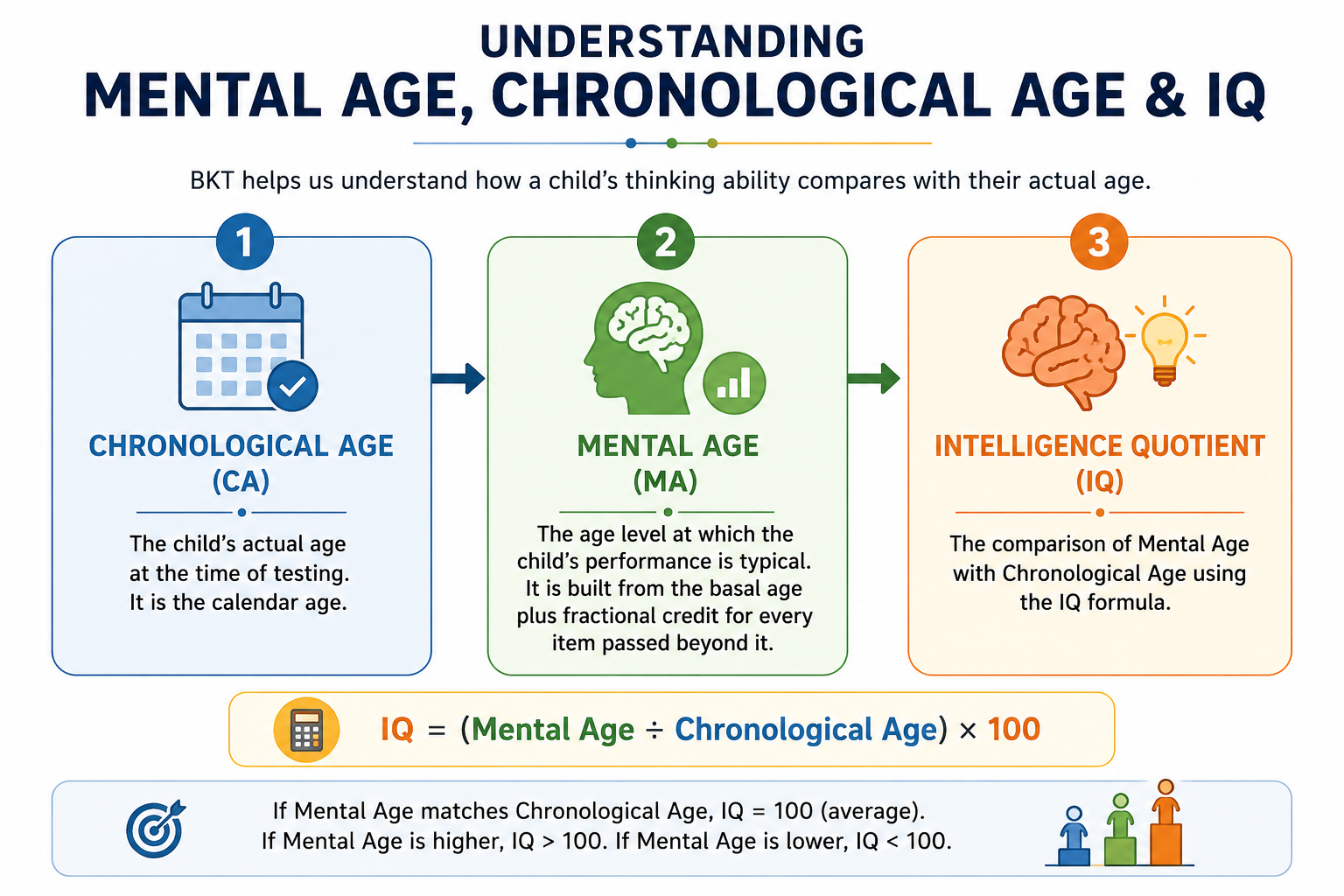
Understanding Mental Age, Chronological Age, and IQ
02. RATIONALE
Why Assess Intelligence in Children?
Because children's cognitive profiles change rapidly, individually administered scales like the BKT-R, which allow an examiner to observe not just what a child answers but how they approach a problem, remain valuable even in an era of quick screening tools.
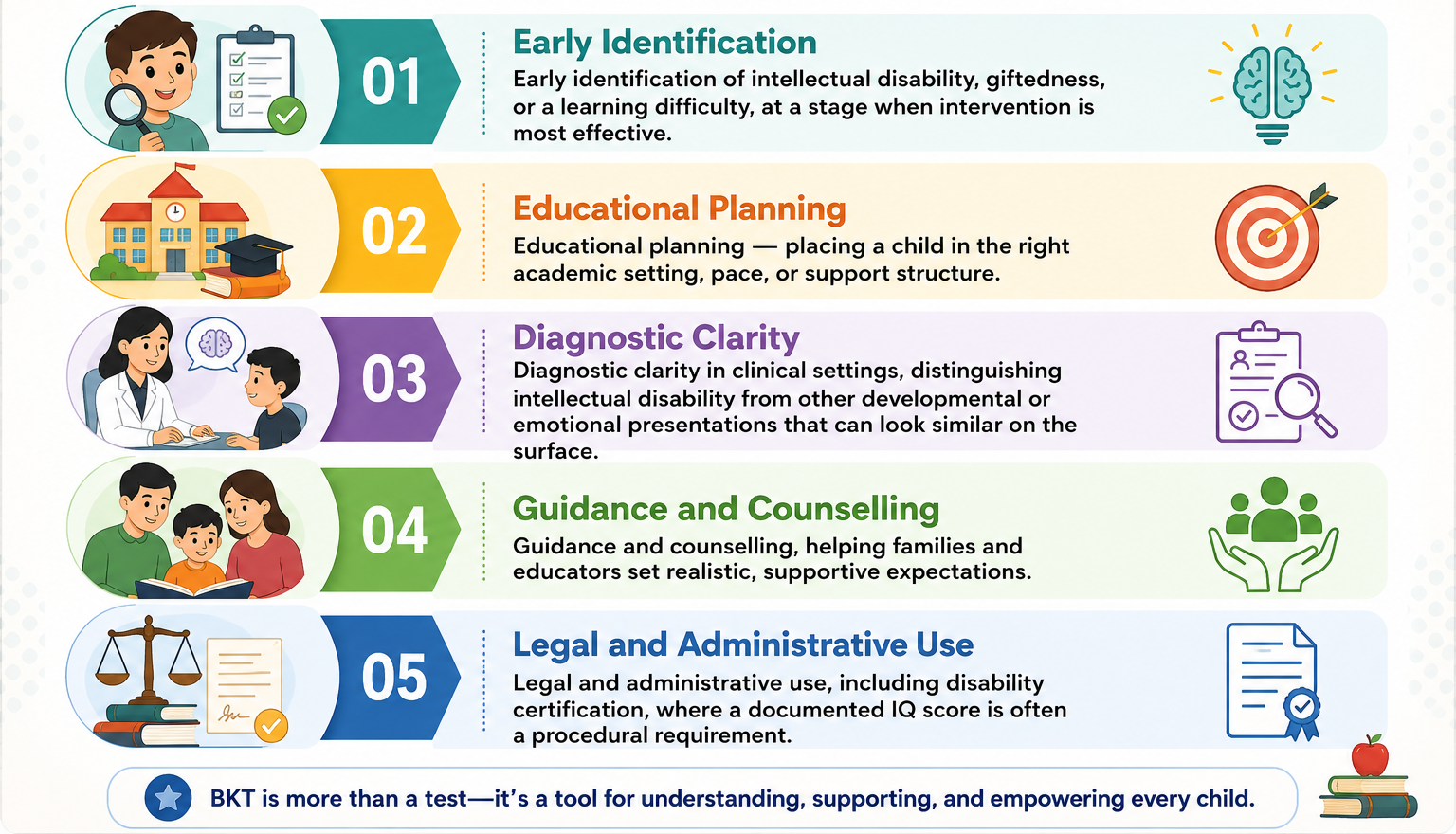
India's own numbers underline the stakes: Census 2011 data show intellectual disability accounts for roughly 18% of registered childhood disabilities, the second most common type after physical disability, and that nearly 75% of India's disabled population lives in rural areas, where diagnostic access is thinnest. Affordable, individually administered tools like the BKT-R sit directly at that access gap.
03. OVERVIEW
Key Features of the BKT-R
Wide age range
Covers 3 to 22 years in a single instrument — unusually broad for an individually administered scale.
Indian standardization
Items, imagery, and norms built around Indian children rather than adapted from Western content.
Bilingual test material
Available in Marathi and Kannada, with items translatable to other Indian contexts in practice.
Mixed item format
Combines verbal subtests with non-verbal, performance-based tasks.
Age-scale design
13 age levels, each with six subtests — retained from the original Binet-Simon architecture.
Low cost, easy training
Simple materials and manual make it accessible to institutions with limited resources.
Because the item order can be adjusted by the examiner to suit a child's interest and comfort rather than requiring strict sequence the BKT-R also tends to be more manageable with younger or anxious children than more rigidly structured batteries.
04. STRUCTURE
Domains and Cognitive Abilities Assessed
Each of the 13 age levels contributes items toward six recurring domains, giving the BKT-R a fairly comprehensive picture of a child's cognitive profile rather than a single composite score alone.
Language
Vocabulary, comprehension, and sentence construction, in the child's own language.
Conceptual Thinking
Similarities, differences, and grouping ideas or objects meaningfully.
Reasoning
Logical problem-solving and analogical thinking, scaled to each age band.
Memory
Immediate recall — digit and sentence repetition, sequence retention.
Visuomotor Skill
Non-verbal, performance-based tasks: copying, construction, coordination
Social Intelligence
Practical and social judgment, assessed both verbally and non-verbally.
05. PROCEDURE
How is the BKT-R Administered?
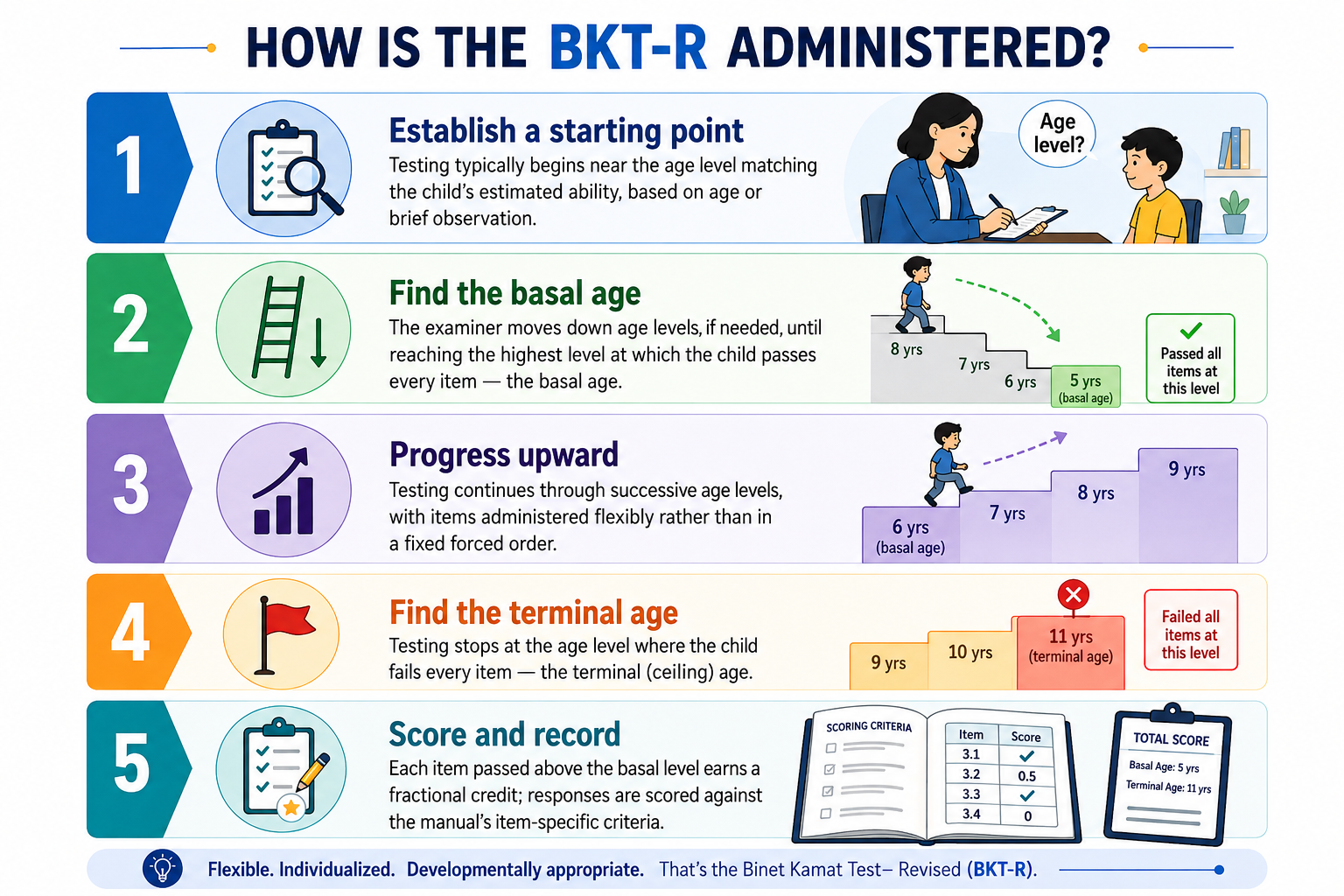
Because it is administered one-on-one, the BKT-R also gives the examiner room to observe behaviour, attention, and problem-solving style — qualitative information that a raw score alone cannot capture.
06. APPLICATIONS
Applications of the Binet Kamat Intelligence Test-Revised (BKT-R)
Clinical assessment
Widely used in hospitals and clinical psychology settings to evaluate intellectual functioning.
Disability certification
A documented IQ score is often part of the process for certifying intellectual disability in India.
Special education placement
Guides decisions about appropriate schooling, pacing, or additional academic support.
Training and research
A core component of nearly every M.Phil clinical psychology programme's assessment syllabus in India.
Vocational and career guidance
Its wide age range extends its use into guidance for older adolescents and young adults.
Screening in institutional settings
Used in schools and community health settings where cost and simplicity matter.
07. IMPACT
Benefits of Early Intelligence Assessment
Testing a child early, rather than waiting for difficulties to become pronounced, changes what is possible in terms of support:
- Timely intervention—developmental and educational support is generally most effective when started early.
- Accurate placement—avoids years spent in a schooling environment mismatched to the child's actual ability level.
- Reduced misattribution—helps distinguish a genuine cognitive difficulty from, say, a language barrier, anxiety, or an unaddressed sensory issue.
- Informed family decisions—gives parents and caregivers a clearer, evidence-based picture to plan around.
- Access to entitlements—formal assessment is often the gateway to disability benefits, resource allocation, and legal protections.