
Upasna Srivastava
PhD Scholar
20 min read
August 22, 2026
Introduction
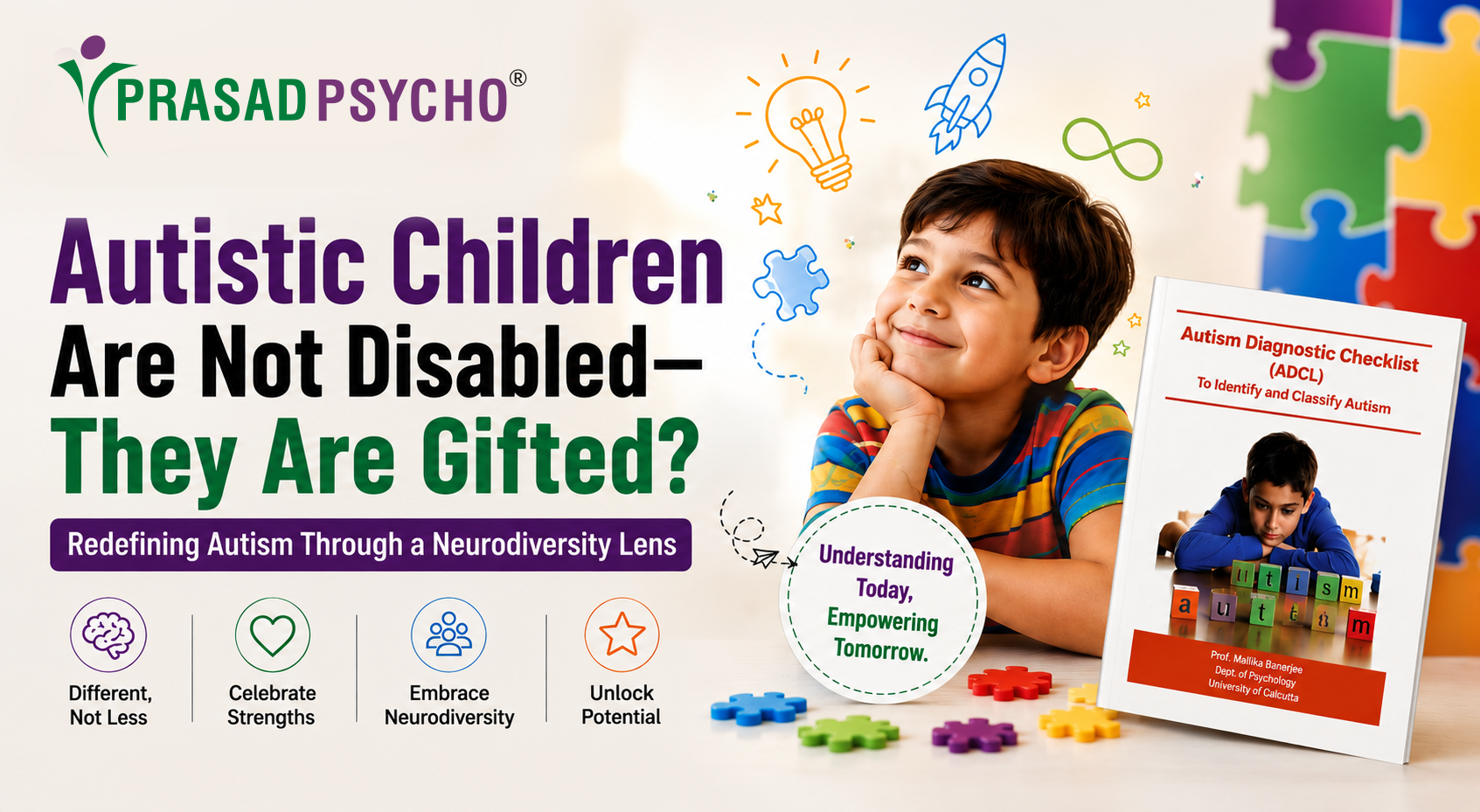
Over the past decade, the neurodiversity paradigm has reshaped how autism is talked about in classrooms, in therapy rooms, and on social media. It replaced the old language of “deficit” and “disorder” with language of “difference” and “variation.” That shift has done really good: it has reduced shame, validated autistic adults' own accounts of their experience, and pushed clinicians toward strengths-based practice. But the popular slogan in this article's title that autistic children are not disabled but simply gifted is a distortion of what the neurodiversity movement actually argues, and it can quietly harm the children it means to celebrate.
This piece lays out the balanced picture: what neurodiversity actually claims, what recent (2025–2026) research and controversies show, and the full map of psychological, physical, emotional, and social factors that shape an autistic child's life — including real risk and support needs that a “just gifted” framing tends to erase.
What Autism Actually Is
Autism Spectrum Disorder (ASD) is a neurodevelopmental condition present from early childhood, marked by differences in social communication and interaction, alongside restricted or repetitive patterns of behaviour, interests, or sensory processing. “Spectrum” is the operative word: it is not a line from “mild” to “severe” but a constellation — a child may need substantial daily support with communication while reading two grade levels ahead in mathematics, or vice versa. No two autistic children present identically.
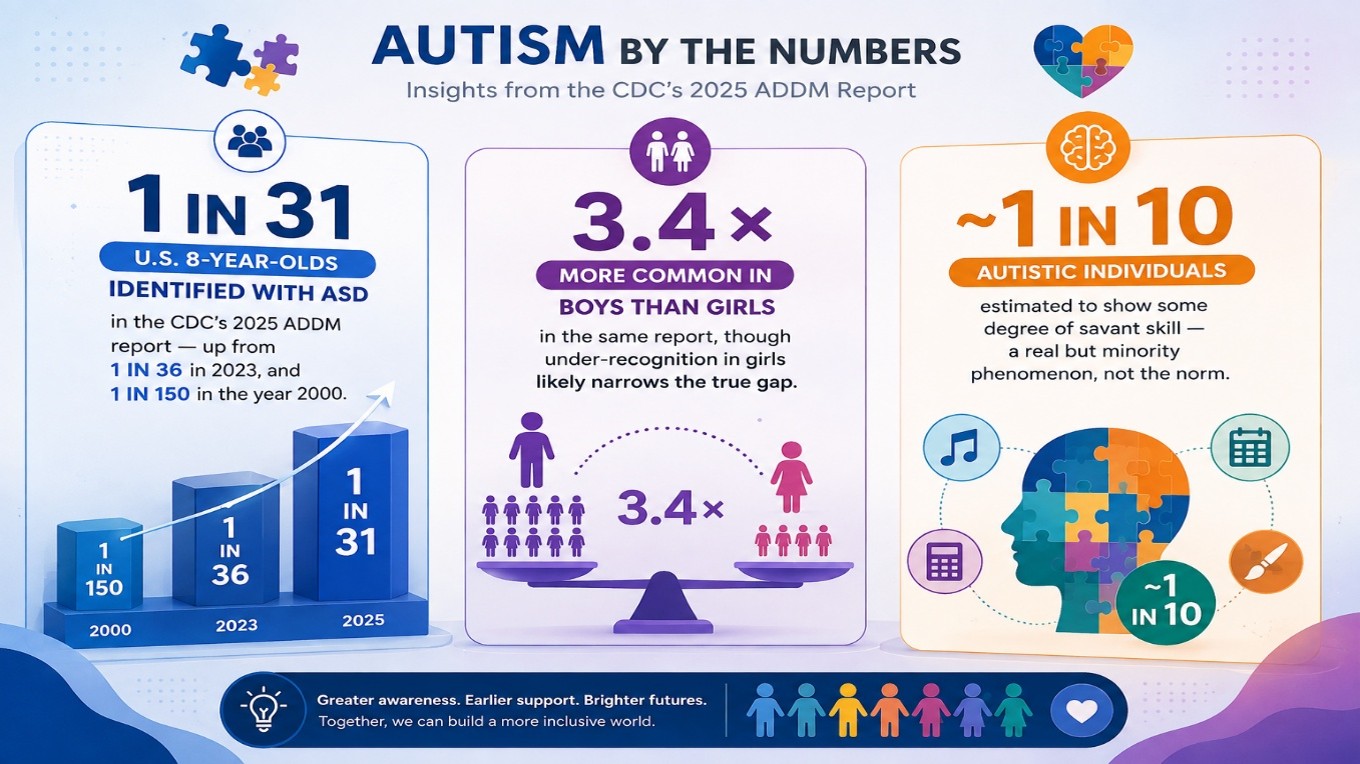
Source: CDC ADDM Network, April 2025 Community Report; Treffert Centre savant syndrome data, 2025.
The CDC report also found identification rising fastest among Asian, Black, and Hispanic children — a trend attributed largely to improved access to evaluation in previously underserved communities rather than a true change in underlying rates, alongside contributing factors like disparities in preterm birth and lead exposure.
Kanner syndrome (1943)
- First described by Leo Kanner as early infantile autism.
- He considered it rare.
- Later, Lotter (1966) estimated prevalence at 4.5 per 10,000 children.
Triad of impairments (1979)
- Wing and Gould found autism-related difficulties in social interaction, communication, and imagination.
- They also noted repetitive behavior patterns.
- Total prevalence in their study was about 20 per 10,000 children.
- This helped define the broader autism spectrum.
Asperger syndrome (1993–1995)
- Asperger described children with autism-like traits but average or above-average language and abilities.
- Ehlers and Gillberg (1993) found 36 per 10,000 definite Asperger syndrome cases, plus 35 per 10,000 with social difficulties.
- Wolff (1995) highlighted a subtler end of the spectrum, where children often need support despite seeming high functioning.
Autism spectrum (2005–2006)
- UK data estimated autism prevalence at 0.9% in 2005.
- Baird et al. (2006) found 38.9 per 10,000 for childhood autism and 77.2 per 10,000 for other spectrum conditions.
- Overall prevalence was 116 per 10,000, though this was likely a minimum estimate.
Autistic adults (2007)
- A UK survey found 1% of adults were autistic.
- Later estimates suggested around 1.1% of people in England are autistic.
Recent studies (2008–2012)
- USA: autism prevalence ranged from 1 in 88 to 1 in 50 in different studies.
- Sweden: 11.5 per 1,000.
- South Korea: 2.64% partly because many undiagnosed cases were found in mainstream schools.
- Differences in rates are likely due to broader diagnostic criteria, better awareness, and different methods.
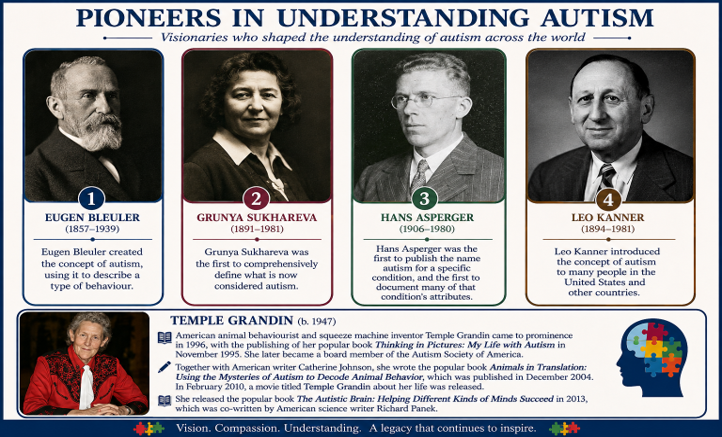
Where “Neurodiversity” Actually Comes from And What It Really Says
The term was coined in the late 1990s by sociologist Judy Singer and popularised by autistic self-advocates like Jim Sinclair, whose landmark essay “Don't Mourn for Us” asked parents to stop grieving the “normal” child they didn't get and start relating to the autistic child they have. The movement's central claim is not that autism carries no disability it's that autism is a naturally occurring variation of the human brain, not a disease to be cured, and that many of the difficulties autistic people face come from a mismatch between their neurology and an environment built for neurotypical people (the “social model of disability”), not purely from deficits inside the person.
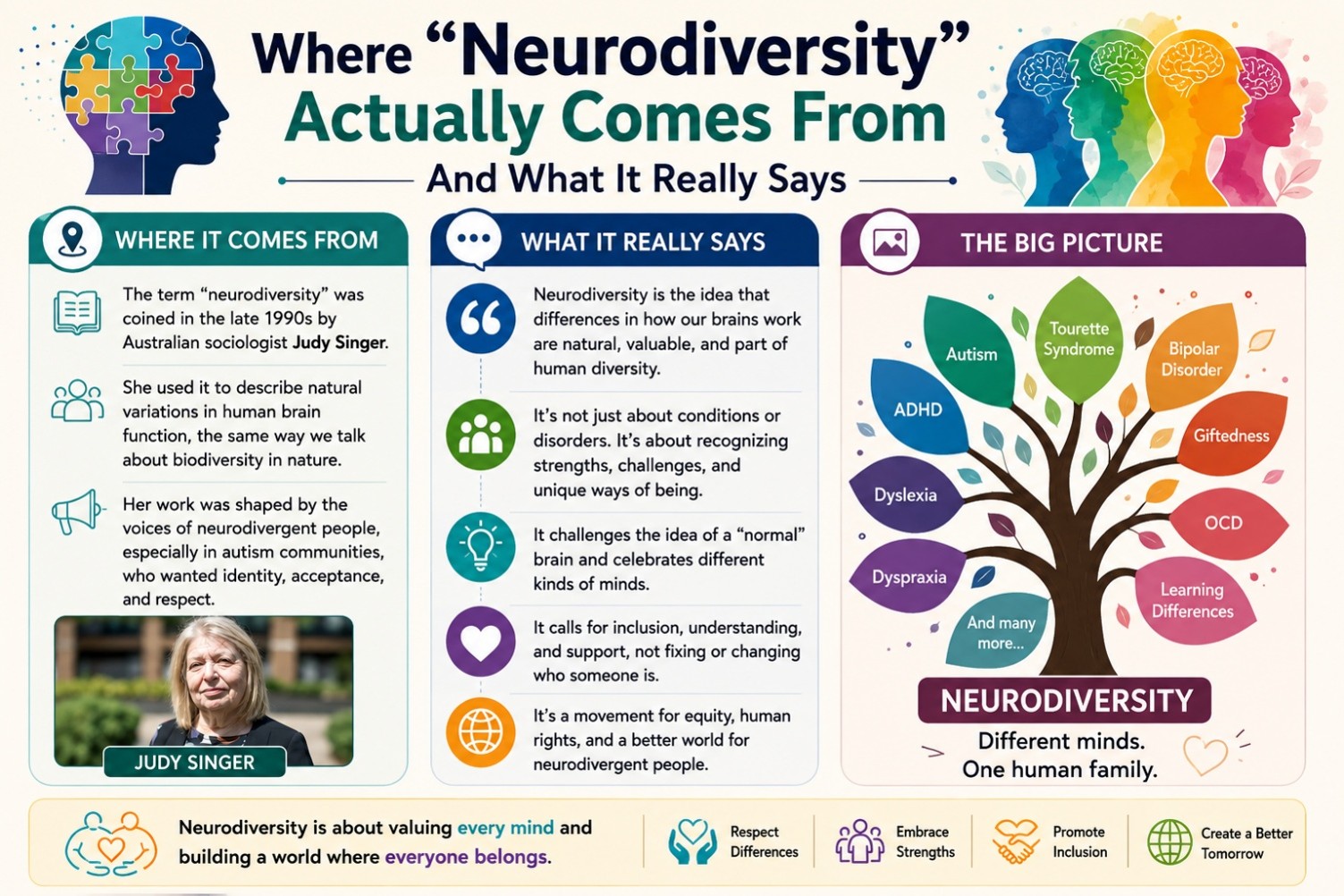
What Neurodiversity Does Not Claim
Serious neurodiversity scholars and autistic self-advocacy organizations (e.g. the Autistic Self Advocacy Network) are explicit that framing autism as “difference, not deficit” does not mean autism is never disabling. Many autistic people, particularly those with high support needs, intellectual disability, or limited spoken language face genuine, significant disability that requires lifelong support. The movement's argument is about dignity and rights within that reality, not a denial of it.
Nobody grieves for a person born with brown eyes instead of blue. Yet difference itself is not what people are mourning; it's the barriers built around the difference.
— paraphrased from the ethos of the neurodiversity self-advocacy movement, following Sinclair (1993)
This is why most autism researchers and clinical bodies now favour strengths-based, identity-affirming practice alongside, not instead of, clinical support: teaching self-advocacy and honouring special interests, while still providing speech therapy, occupational therapy, or behavioural support where a child needs it.
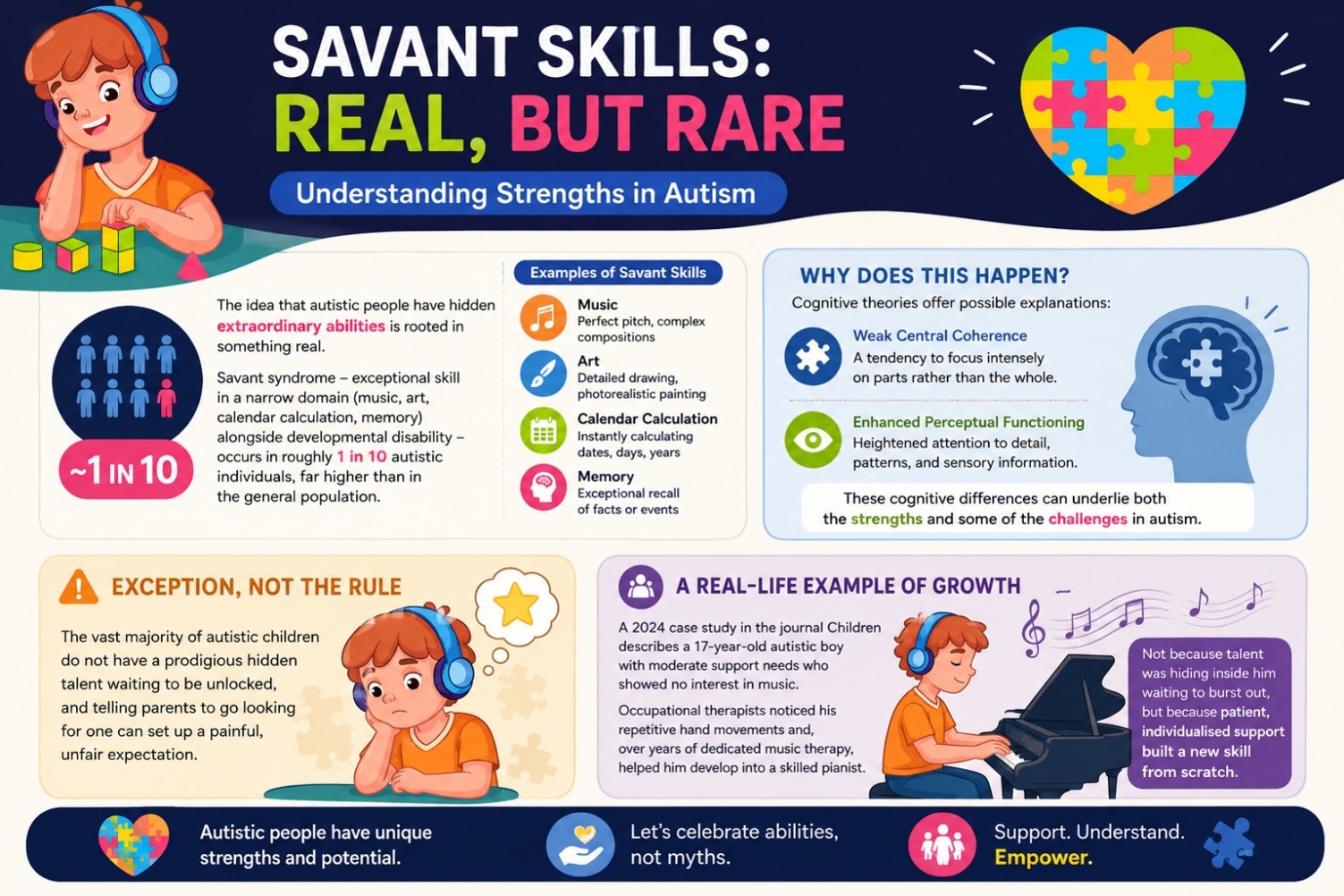
The idea that autistic people have hidden extraordinary abilities is rooted in something real. Savant syndrome exceptional skill in a narrow domain (music, art, calendar calculation, memory) alongside developmental disability occurs in roughly 1 in 10 autistic individuals, far higher than in the general population. Cognitive theories such as “weak central coherence” (a tendency to focus intensely on parts rather than the whole) and enhanced perceptual functioning are thought to underlie both autistic strengths and some of the challenges.
But savant syndrome is the exception, not the rule. The vast majority of autistic children do not have a prodigious hidden talent waiting to be unlocked, and telling parents to go looking for one can set up a painful, unfair expectation. A 2024 case study in the journal Children is a useful, honest illustration: a 17-year-old autistic boy with moderate support needs showed no interest in music until occupational therapists noticed his repetitive hand movements and, over years of dedicated music therapy, helped him develop into a skilled pianist not because talent was hiding inside him waiting to burst out, but because patient, individualised support built a new skill from scratch.
THE MORE USEFUL REFRAME
Instead of “every autistic child is secretly gifted,” clinicians increasingly favour: every autistic child has a genuine profile of strengths and needs, and both deserve equal attention. A child's intense focus, pattern recognition, honesty, or deep subject knowledge are real assets worth building an education around — regardless of whether they ever produce a headline-worthy talent.
2025–2026 in Review: Recent Cases and Developments
CDC's ADDM Network raises the U.S. autism estimate to 1 in 31 children
The Centers for Disease Control's latest surveillance of 16 U.S. communities found autism identification continuing to climb, with the median diagnosis age dropping toward age four. The CDC's own analysis attributed the rise chiefly to better screening and access, not a new environmental trigger or a conclusion contested politically, as covered below.
The Tylenol (acetaminophen) claim, and the scientific pushback
In September 2025, the White House and then-HHS Secretary Robert F. Kennedy Jr. announced a link between prenatal acetaminophen (Tylenol) use and autism, urging pregnant women to avoid it and directing the FDA to update its safety labeling. Major medical bodies, including the American College of Obstetricians and Gynecologists and the Autism Science Foundation, immediately pushed back, calling the evidence limited, conflicting, and inconsistent. By late October 2025, Kennedy himself walked the claim back, acknowledging there was not sufficient evidence to say acetaminophen definitely causes autism.
Evidence for at least two biologically distinct autism subtypes
A large 2026 study combining brain scans from nearly 1,000 autistic individuals with genetic data identified at least two biologically distinct subtypes of autism, each marked by a different pattern of brain connectivity. Findings like this reinforce what clinicians have long observed anecdotally: “autism” is not one condition with one cause, but an umbrella covering multiple neurodevelopmental pathways that happen to produce overlapping behavioural presentations.
Gut microbiome linked to prenatal brain development pathways
Ongoing research into the gut-brain axis suggests some groundwork for brain development may be shaped before birth through interaction between a baby's genes and maternal/gut microbes — part of a growing body of work exploring immune and microbiome pathways in autism, alongside genetics, as a frontier for understanding risk.
Autistic and non-autistic people move their faces differently, not “less”
New research comparing facial movement during emotional expression found autistic participants use genuinely different, not simply diminished, facial patterns when expressing anger, happiness, or sadness. This supports a difference-based rather than deficit-based reading of social communication differences — autistic expression may be missed by neurotypical observers rather than absent.
Causes and Risk: What Actually Increases the Likelihood of Autism
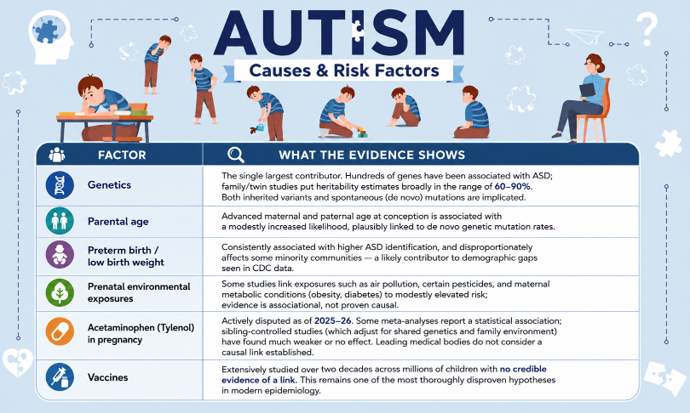
No single cause of autism has been identified, and contrary to viral claims, none is expected to be found, because autism is understood to arise from a heterogeneous mix of genetic predisposition and prenatal/perinatal environmental influences acting together.
CLINICAL NOTE
For families and educators, the practical takeaway is the same regardless of exact cause: autism is not the result of “bad parenting,” vaccination, or any single choice a parent made. Early identification and individualised support consistently predict better developmental outcomes far more reliably than any pursuit of a single “cause.”
The Full Picture: Psychological, Physical, Emotional, and Social Factors
A genuinely neurodiversity-affirming view still requires looking honestly at every domain of a child's functioning because support only works when it's built on an accurate picture, not a flattering one.
Psychological
- High co-occurrence with ADHD, anxiety disorders, and OCD-spectrum traits
- Differences in executive function: planning, cognitive flexibility, working memory
- Uneven cognitive profile: significant strengths alongside significant challenges in the same child
- Elevated risk of depression and low self-esteem, often tied to years of social rejection rather than autism itself
Physical
- Motor coordination differences (gait, handwriting, praxis) in a substantial minority
- Gastrointestinal issues (reflux, constipation, food sensitivity) are common more in neurotypical peers
- Sleep-onset and sleep-maintenance difficulties are highly prevalent
- Sensory processing differences: hyper- or hypo-sensitivity to sound, light, texture, pain
Emotional
- Alexithymia (difficulty identifying/naming internal emotional states) is common, though not universal
- Meltdowns and shutdowns reflect neurological overload, not defiance or a critical distinction for caregivers
- Deep, often intense positive emotion around special interests is a genuine strength for motivation and joy
- Rejection sensitivity built from repeated social mistreatment over childhood
Social
- “Masking” (consciously suppressing autistic traits to fit in) is linked to exhaustion and higher anxiety, especially in girls
- Diagnostic bias means girls and children from marginalised communities are identified later, on average
- Stigma and low teacher/peer awareness remain leading barriers to inclusion, more than the condition itself
- Family stress and caregiver burnout are real, common, and deserve support in their own right
A Working Synthesis, Not a Slogan
The honest, clinically responsible version of this blog title is not “autistic children are not disabled, they are gifted.” It is closer to this: autism is a form of neurological difference that confers real strengths and real support needs at the same time, in proportions unique to each child, and dignifying the strengths should never come at the cost of denying or under-resourcing the needs.
For parents, educators, and clinicians, that means three things in practice:
- Assess honestly. Map both the child's genuine strengths and their genuine areas of need—sensory, communicative, emotional, academic—without assuming either extreme in advance.
- Support without pathologizing or romanticizing.Occupational therapy, speech-language support, and accommodations are not admissions of brokenness; they are tools, the same as glasses or a hearing aid.
- Build environments, not just interventions. Sensory- friendly classrooms, flexible communication options, and peer education about neurodiversity reduce disability more reliably than trying to “fix” the child alone.
That is what redefining autism through a neurodiversity lens should actually mean: not erasing disability with a feel-good label, but insisting that difference and difficulty can coexist—and that both deserve to be taken seriously.
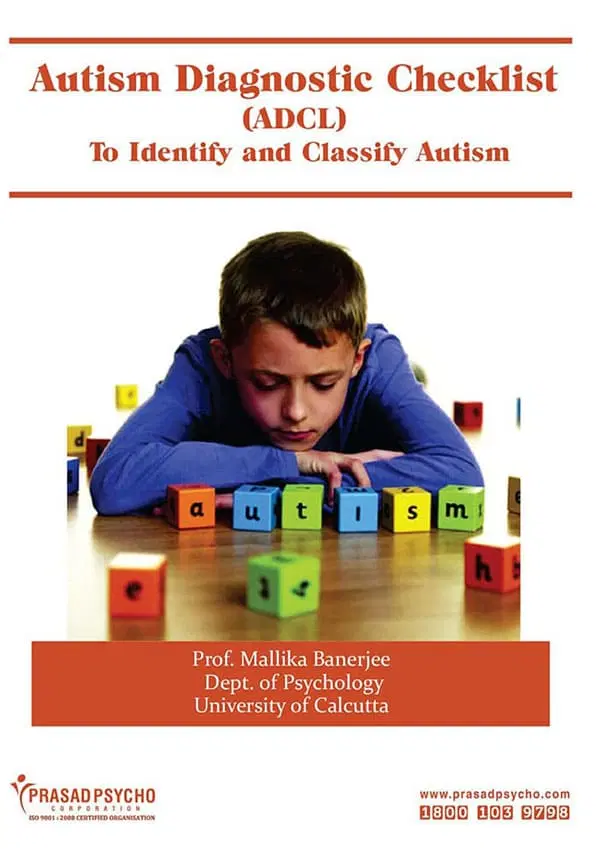
Autism Diagnostic Checklist: To Identify and Classify Autism (ADCL)
Autism Diagnostic Checklist (ADCL): Understanding Autism Through Structured Assessment.
The Autism Diagnostic Checklist: To Identify and Classify Autism (ADCL), developed by Prof. Mallika Banerjee, is a 60-item assessment designed to support the identification and classification of autism-related characteristics in children aged 3–12 years.
The checklist covers six key factors: General Observation, Cognition, Emotion, Social, Communication, and Sensory Dysfunction. It can help assess areas of strength and difficulty across these domains and provide a structured understanding of the child's behavioural and developmental profile.
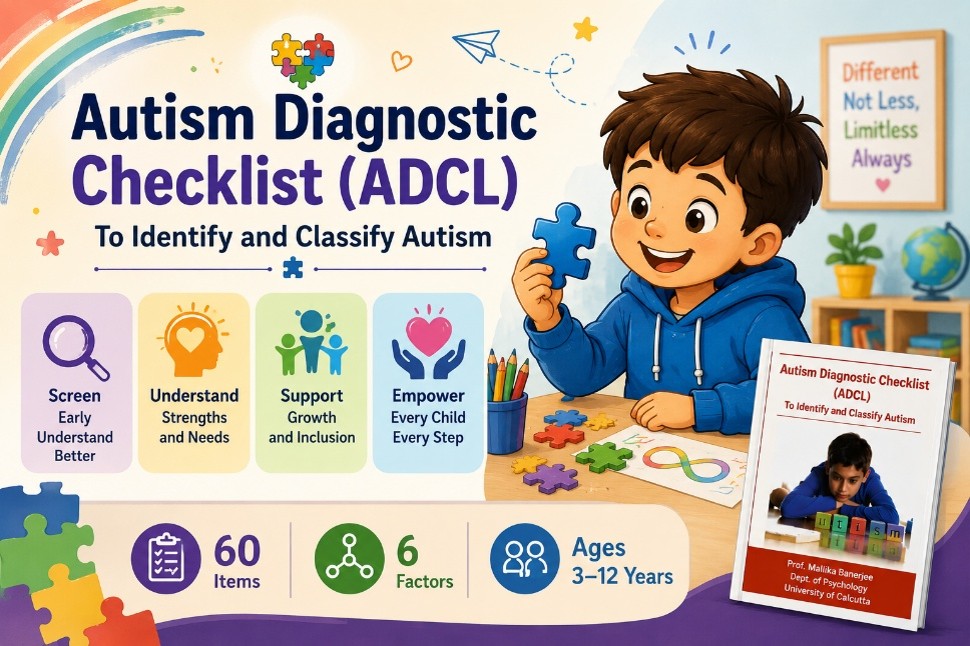
Read the blog and explore the ADCL to learn more about structured assessment of autism.
CLINICAL NOTE
For families and educators, the practical takeaway is the same regardless of exact cause: autism is not the result of “bad parenting,” vaccination, or any single choice a parent made. Early identification and individualised support consistently predict better developmental outcomes far more reliably than any pursuit of a single “cause.”